
When most people think of chamomile, they picture the familiar blue of German Chamomile or the soft apple sweetness of Roman Chamomile. But there is a third chamomile that professionals in perfumery, aromatherapy, and natural cosmetics have long relied on, and it is arguably the most distinctive of the three.
Wild Chamomile, botanically known as Ormenis mixta (also referred to as Ormenis multicaulis or Moroccan Chamomile), offers a character entirely its own. Warm, herbaceous, slightly woody, and deeply grounding, it rewards the formulator who takes the time to work with it.
At ABL Botanicals, we grow and distill Ormenis mixta on our certified organic farms near Marrakech. Here is everything you need to know about this remarkable oil.
What Is Wild Chamomile (Ormenis mixta)?
Ormenis mixta is a flowering plant in the Asteraceae family, native to North Africa and the western Mediterranean. It is commonly called Wild Chamomile or Moroccan Chamomile, though it is botanically distinct from both Matricaria chamomilla (German Chamomile) and Chamaemelum nobile (Roman Chamomile).
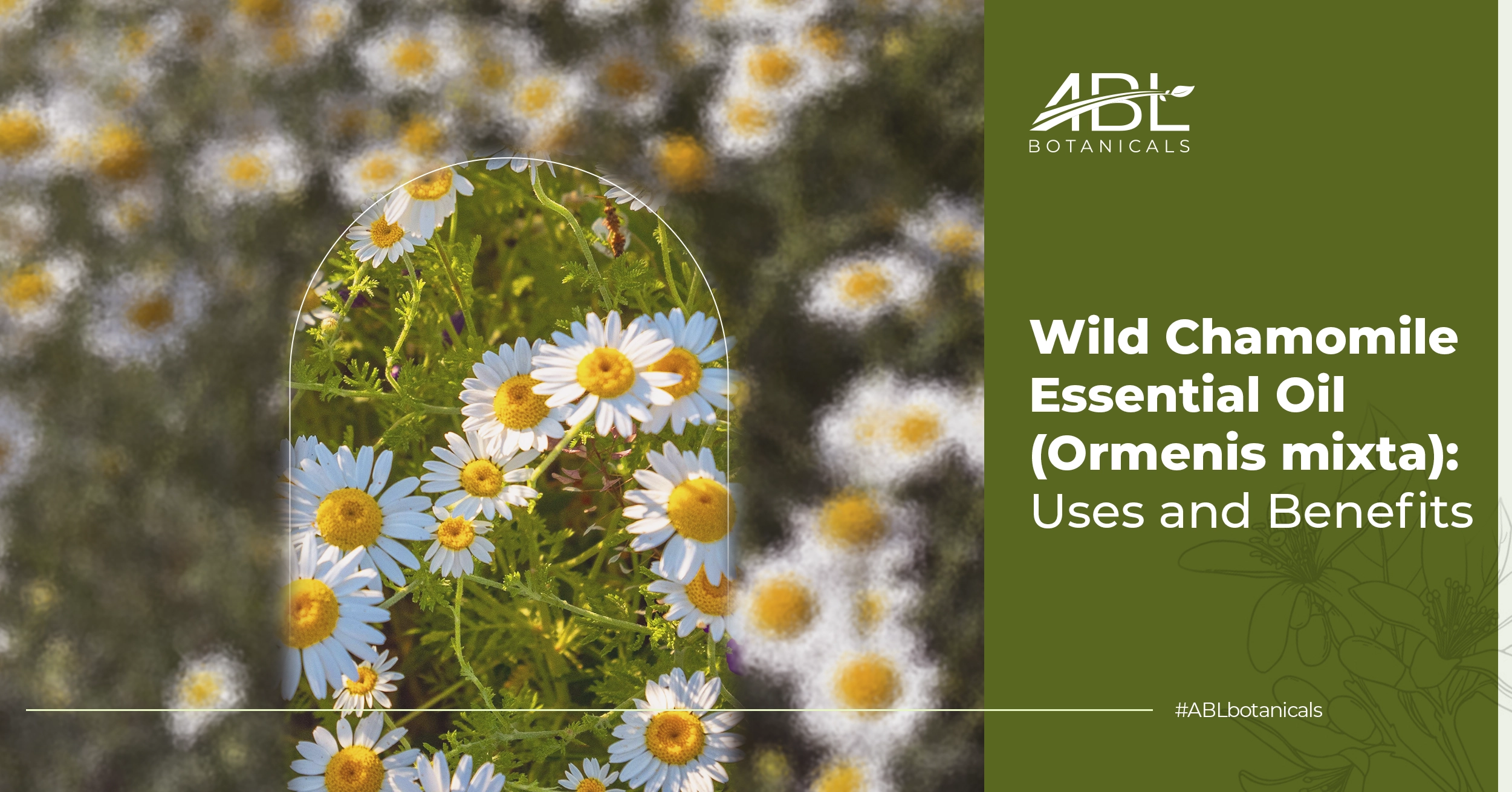
The plant grows wild across Morocco’s landscape and has been cultivated there for essential oil production for decades. It reaches roughly 50–70 cm in height, producing small white daisy-like flowers with yellow centres, visually similar to other chamomile species, but chemically and aromatically quite different.
The Aromatic Profile of Wild Chamomile Oil
The essential oil of Ormenis mixta is obtained by steam distillation of the flowering tops and aerial parts of the plant. The result is a pale yellow to amber oil with a complex, multi-layered scent that sets it apart from other chamomile oils.
Key aromatic characteristics:
- Warm, herbaceous, and slightly woody base
- Soft floral sweetness in the top notes
- Earthy, camphoraceous depth with subtle fruitiness
- A dry, persistent drydown valued in perfumery
Primary chemical constituents typically include santolina alcohol, artemisia ketone, alpha-pinene, and borneol, a composition that differs markedly from the chamazulene-rich German Chamomile or the ester-dominant Roman Chamomile.
This distinctive chemistry gives Wild Chamomile a broader aromatic range that bridges floral, herbal, and woody fragrance families.
Wild Chamomile vs. German Chamomile vs. Roman Chamomile
It is worth clarifying the key differences between these three chamomile essential oils, as they are frequently confused, particularly in consumer contexts.
| German Chamomile | Roman Chamomile | Wild Chamomile | |
| Botanical name |
Matricaria chamomilla |
Chamaemelum nobile |
Ormenis mixta |
| Oil colour |
Deep blue (chamazulene) |
Pale yellow |
Pale yellow to amber |
| Aroma |
Warm, herbaceous, slightly sweet |
Sweet, apple-like, floral |
Warm, herbaceous, woody, earthy |
| Key constituents | Chamazulene, bisabolol |
Isobutyl angelate, esters |
Santolina alcohol, artemisia ketone |
| Primary uses |
Anti-inflammatory skincare |
Fine fragrance, sensitive skin |
Perfumery, aromatherapy, wellness |
All three have value, but they are not interchangeable. Ormenis mixta deserves recognition as its own ingredient, not simply a substitute.
Uses of Wild Chamomile Essential Oil
Perfumery and Fragrance
Wild Chamomile is a well-regarded material among professional perfumers, particularly in niche and natural fragrance. Its warm, herbal character functions effectively as a middle note anchoring floral compositions, a bridge between bright top notes and resinous or woody bases, and a modifier in fougère-style fragrances, adding naturality and depth. Its tenacity on skin is good for a floral/herbal material, which contributes to its popularity in fine fragrance blending.
Skincare and Natural Cosmetics
While Ormenis mixta does not produce chamazulene, it carries traditionally soothing and calming properties relevant to natural skincare formulation. It is used in facial serums and balms targeting sensitive or reactive skin, body care products where herbal depth and calming intent align, and premium aromatherapy-positioned skincare lines.
Aromatherapy and Wellness
In aromatherapy practice, Ormenis mixta is traditionally associated with calming, grounding, and balancing effects. Its warm, earthy aroma blends well with lavender, bergamot, geranium, cedarwood, and frankincense, making it well suited for diffusion, roll-on wellness products, and bath and body formulations.
Why Morocco Produces the Finest Ormenis mixta
Ormenis mixta grows across the western Mediterranean, but Morocco is where it truly excels, both in quality and volume. Morocco’s dry, semi-arid climate in the foothills of the Atlas Mountains provides the conditions that allow the plant’s aromatic compounds to develop fully. Combined with mineral-rich soils and high-altitude growing sites, the result is an oil with greater complexity and aromatic depth than material sourced elsewhere.
Morocco is the world’s primary commercial source of Ormenis mixta essential oil, and has been for generations. This long tradition of cultivation and distillation means producers here understand the plant deeply, when to harvest, how to distill, and how to preserve quality from field to bottle.
ABL Botanicals: Certified Organic Wild Chamomile from Marrakech
At ABL Botanicals, we grow Ormenis mixta on certified organic farms near Marrakech and distill the plant fresh on-site at peak flowering. Our Wild Chamomile essential oil is:
- Certified organic (CCPB and EU Organic)
- Distilled fresh on-site for maximum aromatic integrity
- Traceable from farm to bottle
- Available in volumes suited to formulation, development, and long-term sourcing
We supply ingredient manufacturers, cosmetic formulators, perfumers, and wellness brands seeking a reliable, quality source for premium Moroccan botanicals.
Working with Wild Chamomile: Formulator Notes
- Blending: Start at 1–3% in a blend. Its character is present but not overpowering, it layers rather than dominates. Pair with lavender, clary sage, geranium, or cedarwood for a grounded herbal character.
- Colour: Pale yellow to amber. No blue (unlike German Chamomile). This makes it cosmetically flexible where colour is a consideration.
- Odour intensity: Medium. It has good persistence and rounds out compositions without fading quickly.
- Storage: Store in a cool, dark place, tightly sealed. Shelf life is typically 2–3 years from distillation with proper storage.
Frequently Asked Questions
Is Wild Chamomile the same as Moroccan Chamomile?
Yes. Wild Chamomile, Moroccan Chamomile, and Ormenis mixta (sometimes listed as Ormenis multicaulis) all refer to the same plant and oil. The name varies by supplier and region.
Is Wild Chamomile oil blue like German Chamomile?
No. Ormenis mixta does not produce chamazulene during distillation, so the oil ranges from pale yellow to amber rather than the vivid blue associated with German Chamomile.
Can Wild Chamomile replace German or Roman Chamomile in formulas?
They are botanically and aromatically distinct. Wild Chamomile is not a direct substitute but can be a deliberate choice when a warmer, more herbaceous chamomile character is desired. Always evaluate in context.
Is ABL Botanicals’ Wild Chamomile oil certified organic?
Yes. Our Ormenis mixta is grown and processed under CCPB and EU Organic certification.
For specifications, availability, or sourcing enquiries and samples, reach us at Sales@ABLbotanicals.com.